Mineral
Hematites
Fe₂O₃ · Óxidos
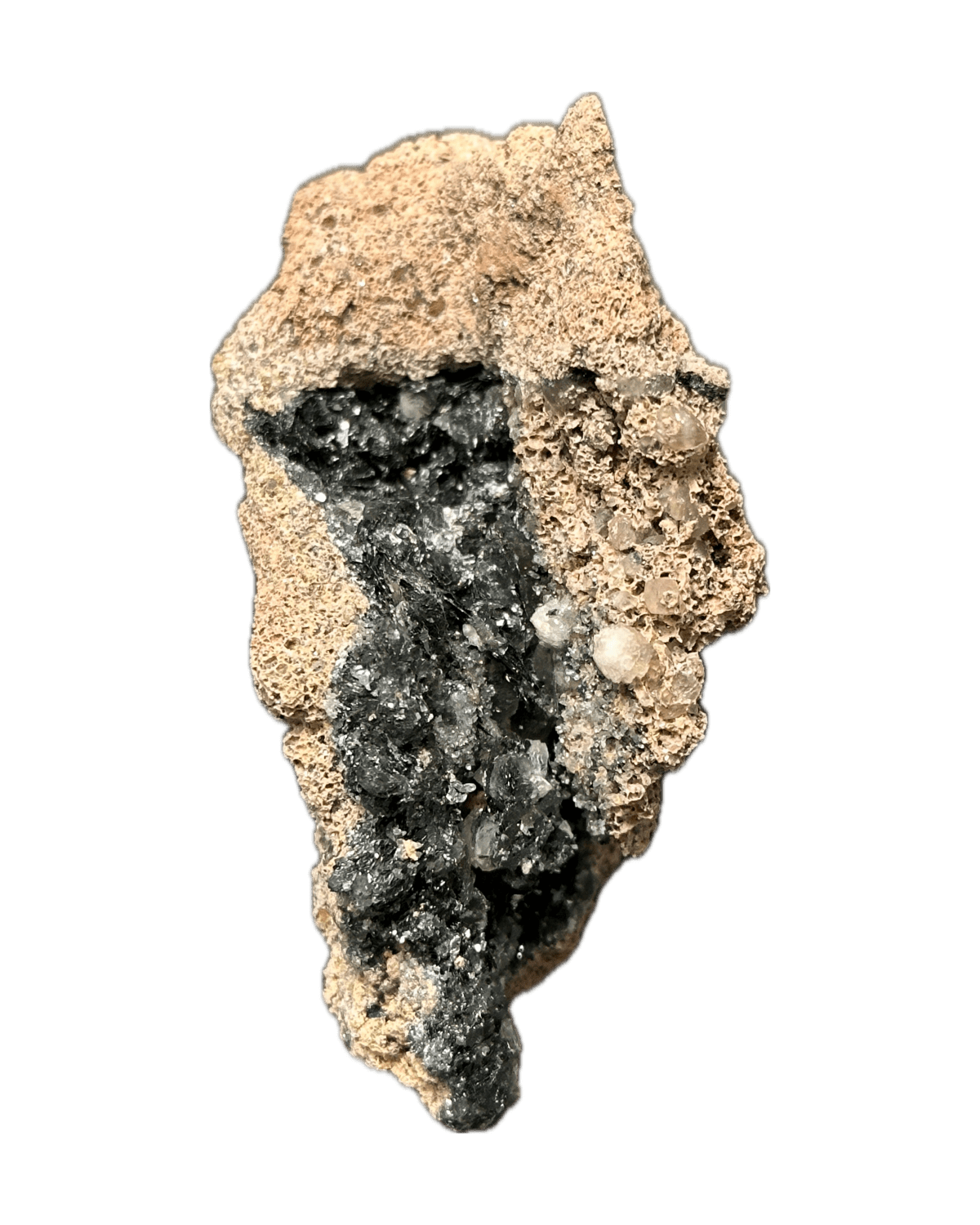
Hematite is a very common iron oxide, recognisable by its metallic lustre in specular varieties and by its red streak.
In botryoidal habit it forms rounded, compact, highly lustrous masses, where the steely black exterior and the red interior express the same ferric nature in two visual readings. Bluish tones arise from very thin oxide films that produce optical interference. It also occurs as crystals in calcite geodes formed within the reddish sandstones of the Buntsandstein.
Its industrial and artisanal role has been enormous. As one of the principal iron ores, it fed the production of the metal for the metallurgical industry. As red ochre, it has been used since prehistoric times as a stable pigment in rock art, ceramics and ritual objects. That dual life—heavy metallic mineral and durable red powder—places it among the most versatile materials in history.
Etymology
Hematite derives from the Greek "haima" (blood), after the deep red colour of its powder. Aragonite is named after Molina de Aragón (Guadalajara), where it was first described.
Specimens in the collection (10)
- Hematites — Mina La Celia, Jumilla, Murcia, Región de Murcia, España № 0008
- Hematites (Tabular) — Djebel Nador, Nador, Nador, Oriental, Marruecos № 0173
- Hematites (Especularita Azul) — Bellerberg Volcano, Nickenich, Eifel, Renania-Palatinado, Alemania № 0310
- Hematites (Tabular) — Djebel Nador, Nador, Nador, Oriental, Marruecos № 0404
- Hematites (Especularita) — Mansilla de la Sierra, La Rioja, España № 0541
- Hematites (Especularita) — La Rioja, España № 0542
- Hematites (Oligisto) — La Rioja, España № 0543
- Hematites (Microbotroidal) — Valderrábanos, León, España № 0600
- Hematites (Microbotroidal) — La Lastrilla, Tordelrábano, Guadalajara, Castilla-La Mancha, España № 0625
- Hematites (Microbotroidal) — Irhoud, Youssoufia, Marrakesh-Safi, Marruecos № 0636