Mineral
Titanita
CaTiSiO₅ · Silicatos (Nesosilicatos)
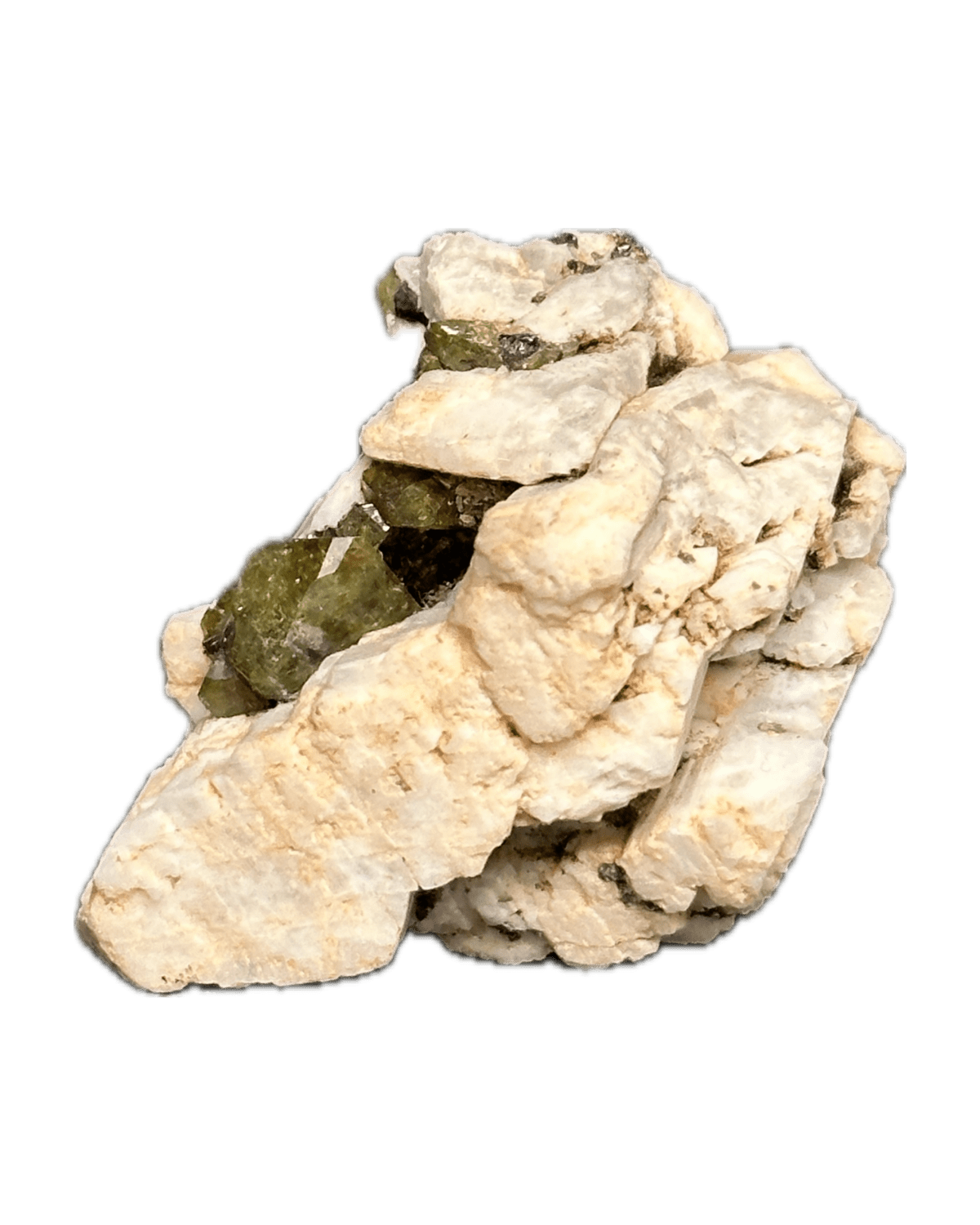
Titanite is a calcium–titanium nesosilicate noted for flat, sharp crystals with wedge- or leaf-like forms.
It occurs as well-defined individual crystals with characteristic wedge geometry, often flat, sharp and with intense vitreous lustre. Colours range from bright olive green to translucent dark brown. In good specimens the appeal lies in the combination of colour, partial transparency and crisp morphology.
It can incorporate trace uranium and rare earth elements. It acts as a small geological clock, enabling dating of crystallisation, metamorphism or fluid-flow episodes via the uranium–lead system. These trace components make it valuable for geochronological studies.
In the gem trade it is frequently known as sphene. Its high dispersion produces a brilliance that, in the best specimens, can exceed that of diamond. Some finds created furore at international fairs in the mid‑2000s for this property.
Etymology
It was initially called "sphene" for its shape (Greek "sphen" = "wedge"). The accepted name "titanite" reflects its titanium content. Titanium was named by Martin Heinrich Klaproth, although William Gregor had discovered the element a few years earlier; Klaproth publicly acknowledged Gregor’s priority. Gregor retained credit for the discovery, while Klaproth’s element name, "titanium", prevailed.
Specimens in the collection (6)
- Titanita — Imilchil, Cercle de Imilchil, Midelt, Drâa-Tafilalet, Marruecos № 0031
- Titanita — Zagi Mountain, Hameed Abad Kafoor Dheri, Peshawar District, Khyber Pakhtunkhwa, Pakistán № 0492
- Titanita — Albatera, Alicante, Valencia, España № 0599
- Titanita — Mula Ghani Baba, Mohmand District, Khyber, Pakhtunkhwa, Pakistan № 0658
- Titanita — Imilchil, Cercle de Imilchil, Midelt, Drâa-Tafilalet, Marruecos № 0672
- Titanita — Imilchil, Cercle de Imilchil, Midelt, Drâa-Tafilalet, Marruecos № 0676