Boltwoodita
Boltwoodita is a mineral with formula K(UO₂)(SiO₃OH) · H₂O, in the Silicatos group. This specimen comes from Mina Rössing, Swakopmund, Erongo, Erongo Region, Namibia.
Description
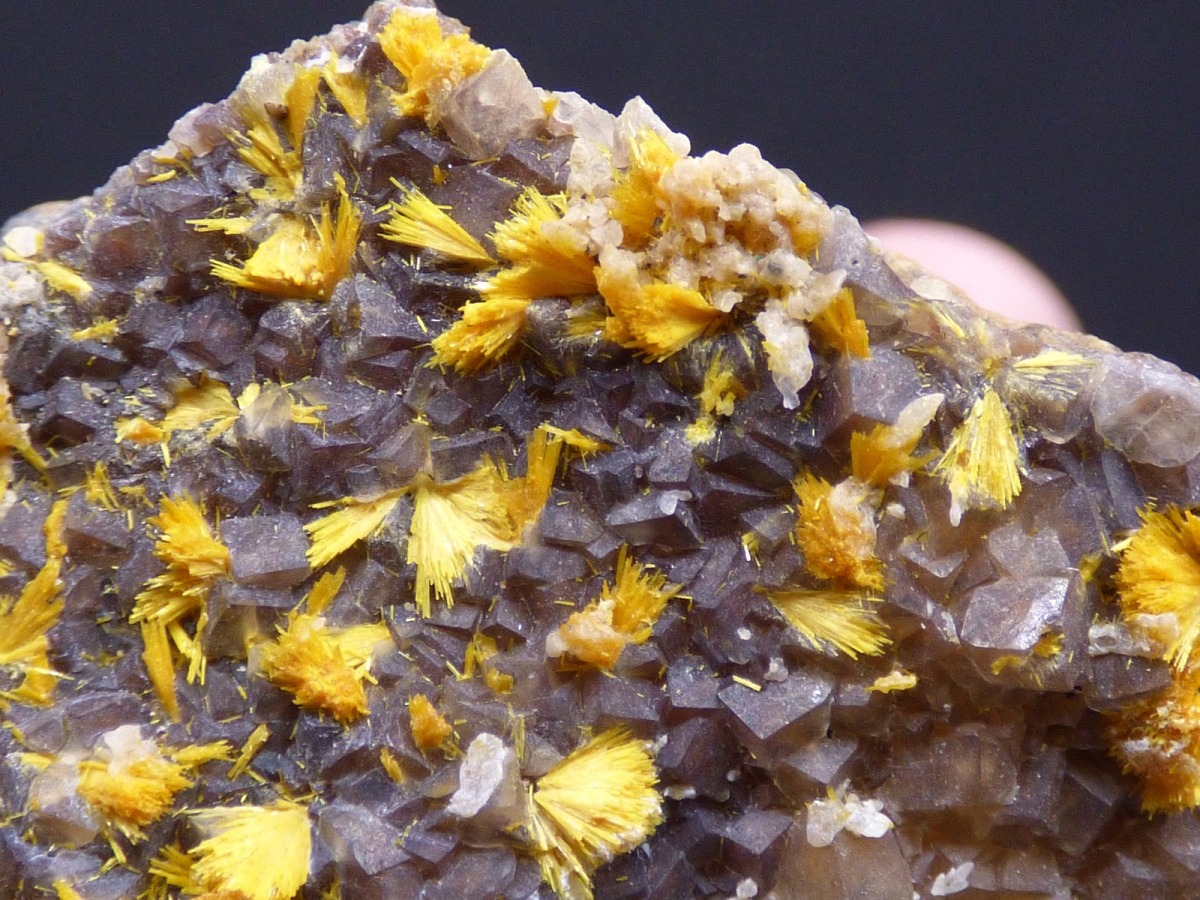
Radiating acicular aggregates of yellow boltwoodite forming sprays and fans on calcite cubes. Excellent overall preservation. Very high radioactivity: 13.0 µSv/h at close range.
History of this specimen
It comes with the original handwritten label with the locality and acquisition date. It was acquired by Carlos Prieto Paramio on 07/04/1991 at the School of Mines Fair in Madrid; he bought it from Luis Andrade for 9,000 pesetas. It was originally sold as if the matrix were fluorite, when in fact it is calcite, a common confusion in this kind of historical specimen.
About Boltwoodita
Uncommon uraniferous silicate, characterised by its radiating acicular habit and intense colours. This association with calcite is typical of Namibia.
About the locality
Classic Namibian locality whose boltwoodite was for decades wrongly attributed to the Rössing mine for reasons of mining confidentiality and geographic proximity. The Rössing mine never produced crystallised boltwoodite; the historic specimens on the market actually come from Goanikontes. This confusion is part of the mineralogical history of the species.
Technical data
- Catalogue No.
- 0165
- Composition
- K(UO₂)(SiO₃OH) · H₂O
- Name
- Boltwoodita
- Group
- Silicatos
- Category
- Núcleus Ardens
- Matrix
- Calcita
- Associations
- calcita
- Mine
- Mina Rössing
- District / Municipality
- Swakopmund
- Province
- Erongo
- Region
- Erongo Region
- Country
- Namibia
- Size (cm)
- 6 x 3.5 x 0.8
- Weight
- 25.3 g
- Ex-collection
- Carlos Prieto Paramio
- Etymology
- Named in honour of Bertram Boltwood (1870–1927), an American chemist whose principal contribution was to show that lead is the end product of uranium decay. In 1907 he proposed the use of the uranium–lead ratio as a method for dating rocks.
- Quality
- Notable
- Value trend
- Al alza
Related specimens
- Asbesto —
- Berilo (Aguamarina) — Namibia
- Calcedonia Estalactítica — India
- Cuarzo (Ahumado rutilado) —
- Jacinto de Compostela — España
- Elbaíta (Rubelita) — Afganistán
- Fulgurita (Lechaterielita) — Níger
- Fulgurita (Lechaterielita) — Níger