Gummita Pseudomorfo de Uraninita
Gummita is a mineral with formula Mezcla compleja: U-silicatos, óxidos e hidróxidos (Kasolita, Curita, Soddyita, Uranofana...), in the Óxidos / Silicatos (Uranilo) group. This specimen comes from Chenzema (Tschensema), Montañas Uluguru, Morogoro, Tanzania.
Description
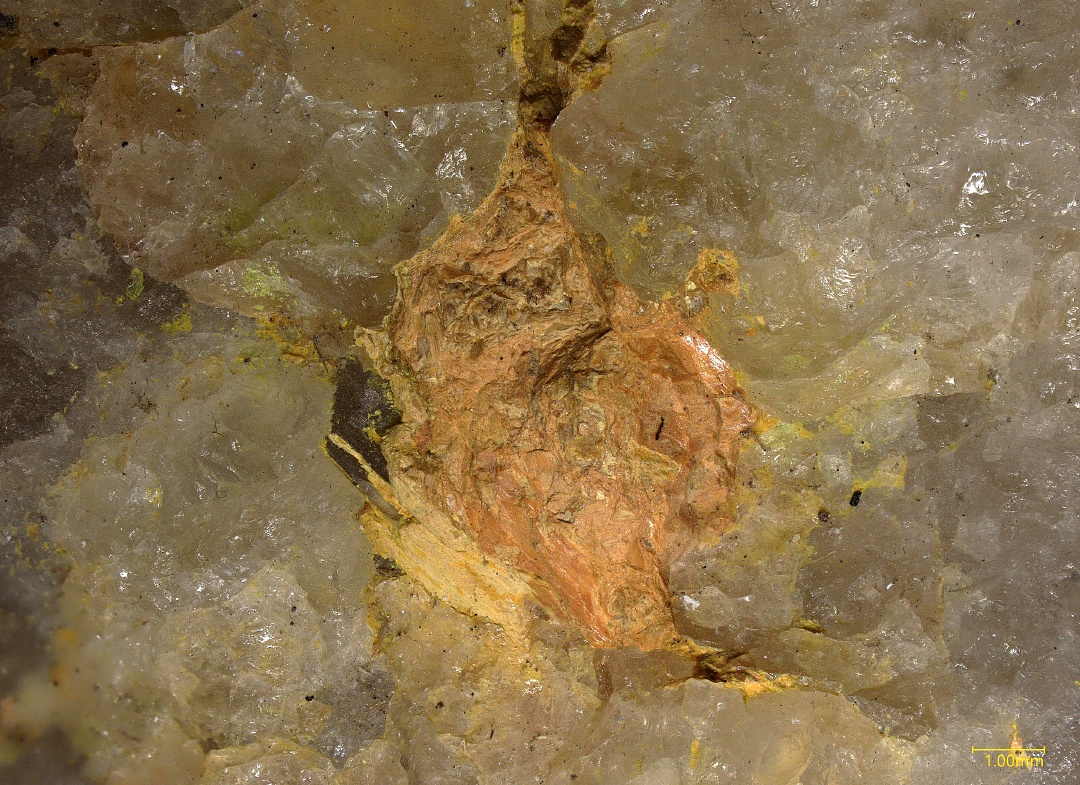
La Superabuela. Intense yellow-orange alteration crust (gummite) preserving the original cubic form of a uraninite crystal, set in white pegmatitic quartz matrix. The piece is a "mineral cadaver": the original uranium has completely oxidised, generating secondary silicates. Shows high radioactivity.
History of this specimen
I acquired it at auction, where it went unnoticed despite its immense historical weight. My forensic investigation of its multiple labels revealed 90 years of traceability. It was catalogued in February 1935 by Dr Nottmeyer, a geologist verified in the archives of TU Bergakademie Freiberg (Forschungsstelle für kolonialen Bergbau fonds). Nottmeyer was in Tschensema documenting the operations of "Uluguru-Glimmer-Werke" (Uluguru Mica Co.), which extracted strategic mica for the electrical and military industry. The piece also documents the evolution of scientific language: the labels move from the classic mining term "Uranpecherz" or pechblende (literally "uranium pitch") handwritten by Nottmeyer, through the descriptive "Uranglimmer" ("uranium mica") on the intermediate "Afr. 12" label, to the modern standard "Uraninit" on the University of Bonn card. There it finally entered the "Sammlung Lag." (Deposits Collection) to serve as study material for economic geology.
About Gummita
Gummite is not a mineral species, but a field term describing the advanced alteration state of uraninite. It occurs when water and oxygen are present, and the original structure, already disordered by internal radiation (metamictisation), breaks down and gives rise to a mixture of secondary minerals: uranium oxides and hydroxides—such as becquerelite or schoepite—and silicates—uranophane, kasolite—and, in some cases, phosphates. The result is a waxy material in yellow and orange tones. What is distinctive in this piece is that it is also a pseudomorph: the secondary mixture has occupied the volume of the original cubic uraninite crystal. It is a "mineral cadaver" that preserves the perfect cube form, although its internal composition no longer corresponds to the original uraninite.
About the locality
The Uluguru Mountains were the electrical pantry of the colonial period. Industrial mica (muscovite) was extracted from these pegmatites, a strategic insulator vital for the growing electrical and military industries of the interwar years. Uranium (this gummite) appeared as a curious by-product among the mica sheets. In 1935, when Nottmeyer collected this, uranium scarcely mattered; a few years later, that "waste" would be worth more than the mine itself.
Technical data
- Catalogue No.
- 0294
- Composition
- Mezcla compleja: U-silicatos, óxidos e hidróxidos (Kasolita, Curita, Soddyita, Uranofana...)
- Name
- Gummita
- Variety
- Pseudomorfo de Uraninita
- Group
- Óxidos / Silicatos (Uranilo)
- Category
- Núcleus Ardens
- Matrix
- Cuarzo
- Associations
- Mica
- Mine
- Chenzema (Tschensema)
- District / Municipality
- Montañas Uluguru
- Province
- Morogoro
- Country
- Tanzania
- Size (cm)
- 9 x 5.5 x 5
- Weight
- 303.3 g
- Ex-collection
- Dr. Nottmeyer > H.R. Kohl > Mineralogisches Institut Bonn (Lagerstättensammlung)
- Etymology
- From Latin "gummi" (gum), for its waxy appearance.
- Quality
- Muy buena
- Value trend
- Al alza
Related specimens
- Zoisita (Tanzanita) — Tanzania