Meteorito
Meteorito is a mineral with formula Ni-Fe, in the Elementos Extraterrestres group. This specimen comes from Campo del Cielo, Chaco, Santiago del Estero, Gran Chaco, Argentina.
Description
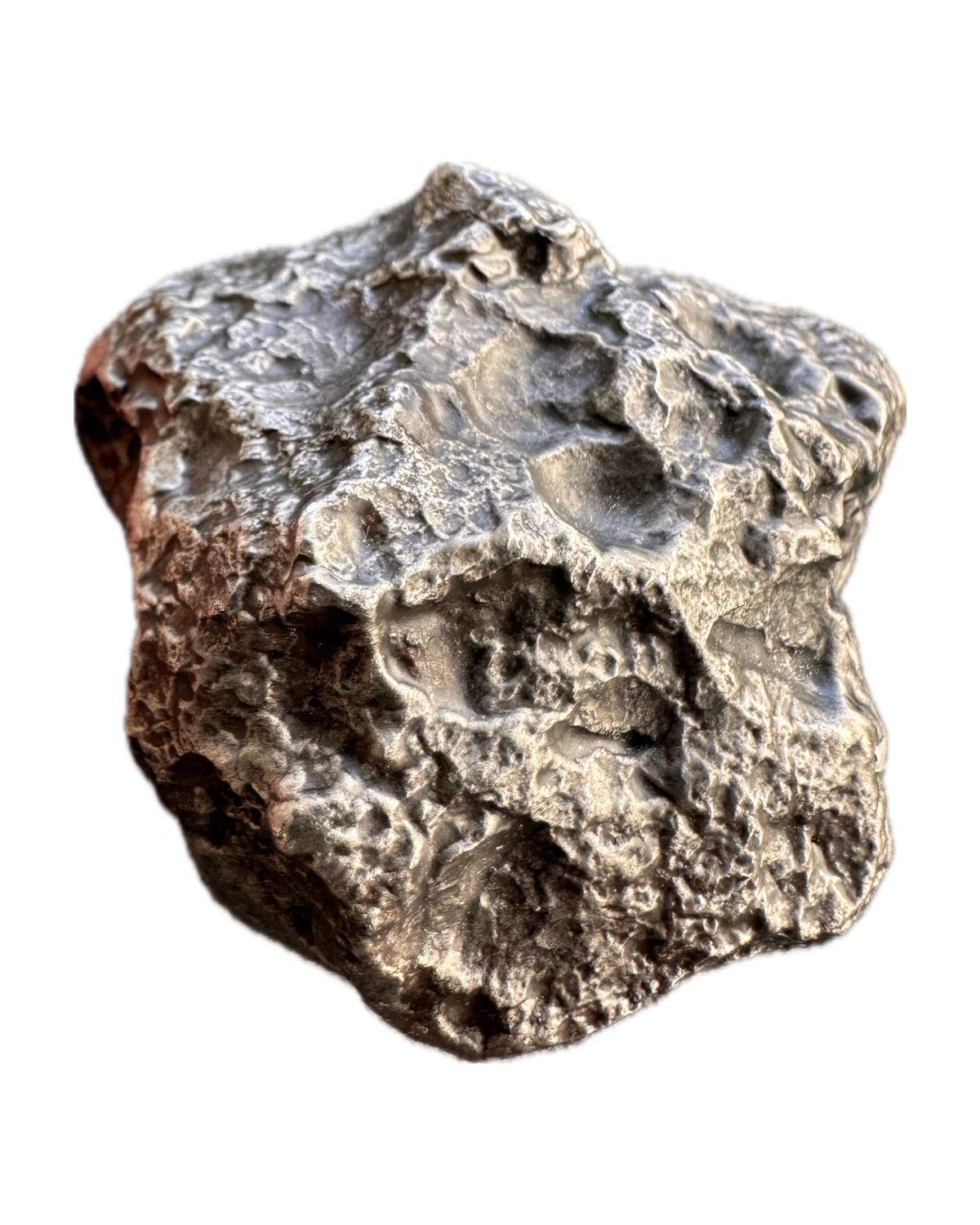
Heavy metallic mass with deep, rounded, dark regmaglypts. Smooth edges and well-defined relief. Very good in-hand presence and pronounced three-dimensionality.
History of this specimen
This fully formed piece was in its origins part of a meteorite which entered the Earth c.4,500 years ago, around 5,000 million years old and about 800 tonnes in mass. During its way through the atmosphere, intense heating and surface ablation sculpted it, forming the characteristic regmaglypts. I stress that these cavities are not dents or prior impacts: a meteorite does not travel through space like that. This morphology forms during the violent passage through our atmosphere at virtually unimaginable velocities. Ahead of the body, air compresses extremely and reaches very high temperatures, generating turbulence and small local vortices. These recirculations concentrate heat and plasma at specific points on the surface, which erode before the rest and end up forming the rounded depressions called thumbprints typical of many meteorites. And, by the way, only 6% of meteorites are iron; there are only a few thousand worldwide.
About Meteorito
It is not a mineral; it is extraterrestrial material. It is a metallic body formed in the earliest stages of the Solar System, part of the core of a protoplanet born 4,500 million years ago. Classified as an IAB-MG iron meteorite, its iron (92%) and nickel (5%) chemistry includes traces of iridium and gallium that link it directly to the asteroid belt. Being a coarse octahedrite, its interior reveals Widmanstätten figures: broad bands of kamacite and taenite that could only form through ultra-slow cooling of about 1°C per million years, a geometric signature impossible to replicate on Earth.
About the locality
Although the origin is listed as Argentina because it is where it was collected, it actually comes from outer space. Its origin is the Cosmos. Campo del Cielo, Argentina, is a large meteoritic strewn field with multiple craters. This occurred because a shower of metallic meteorites fragmented in the atmosphere, scattering thousands of iron–nickel masses over an area of c.3 × 20 km, with at least 26 impacts identified. To date, more than 100 tonnes of material have been recovered, including large masses such as Gancedo and El Chaco. That volume is equivalent to a cubic metallic block of about 2.3 m on a side. This allows calculation that the original body, before fragmentation, probably reached several metres more in diameter (they say around 4 m), although popular estimates are much larger, even close to 800 t. Indigenous peoples already knew these scattered metallic masses before the first European record in 1576.
Technical data
- Catalogue No.
- 0405
- Composition
- Ni-Fe
- Name
- Meteorito
- Group
- Elementos Extraterrestres
- Category
- Meritum Persé
- Mine
- Campo del Cielo
- District / Municipality
- Chaco
- Province
- Santiago del Estero
- Region
- Gran Chaco
- Country
- Argentina
- Size (cm)
- 5 x 4.5 x 3
- Weight
- 205.6 g
- Ex-collection
- Eduardo Llorens
- Etymology
- Meteorite comes from the Greek meteōros, "raised in the air", historically applied to celestial or atmospheric phenomena.
- Quality
- Top
- Value trend
- Estable