Kolm Asfalto uranífero
Kolm is a mineral with formula Materia orgánica bituminosa radioactiva, in the Roca sedimentaria group. This specimen comes from Örsta, Tysslinge, Örebro, Närke, Suecia.
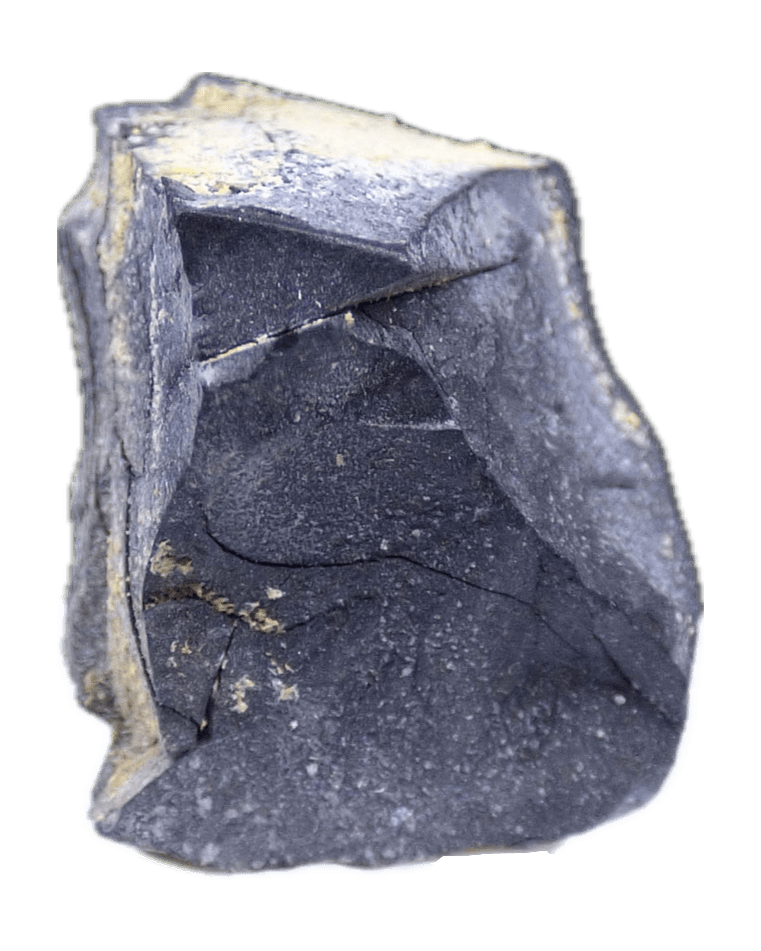
Description
Small irregular fragment of kolm, black and dull, visually close to coal or asphalt. No visible crystals: its interest lies in the bituminous organic matter and uranium distributed through the rock.
History of this specimen
It is a deliberately unassuming specimen whose importance is documentary: at the time of purchase, kolm had no photographs on Mindat, so this traceable sample can provide a visual reference for a poorly represented material.
About Kolm
Kolm is not a mineral but an organic, uranium-rich material: lenses of solid bitumen or kerogen within the Upper Cambrian Alum Shale Formation. Organic matter was preserved in a low-oxygen marine setting and concentrated uranium; the nodules can contain uranium in the thousands of ppm. In an apparently ordinary rock, it links sedimentation, ancient life, hydrocarbons and nuclear energy.
About the locality
Örsta is a hamlet in Tysslinge, Örebro, Närke, Sweden—not Norway. Geological literature documents alum shale along the Örsta–Latorp–Lanna corridor: an Upper Cambrian marine black-shale succession rich in organic matter, pyrite and uranium. It is fully consistent with the kolm occurrences of Närke, especially Kvarntorp.
Technical data
- Catalogue No.
- 0691
- Composition
- Materia orgánica bituminosa radioactiva
- Name
- Kolm
- Variety
- Asfalto uranífero
- Group
- Roca sedimentaria
- Category
- Núcleus Ardens
- Matrix
- Querógeno
- Associations
- Uranio
- Mine
- Örsta
- District / Municipality
- Tysslinge
- Province
- Örebro
- Region
- Närke
- Country
- Suecia
- Size (cm)
- 2.3 x 1.8 x 1.7
- Ex-collection
- Carlos Prieto Paramio
- Etymology
- From Swedish “kolm”, the traditional name applied to the black, organic and uranium-rich material found in Swedish alum shales.
- Quality
- Notable
- Value trend
- Estable