Thomsonita
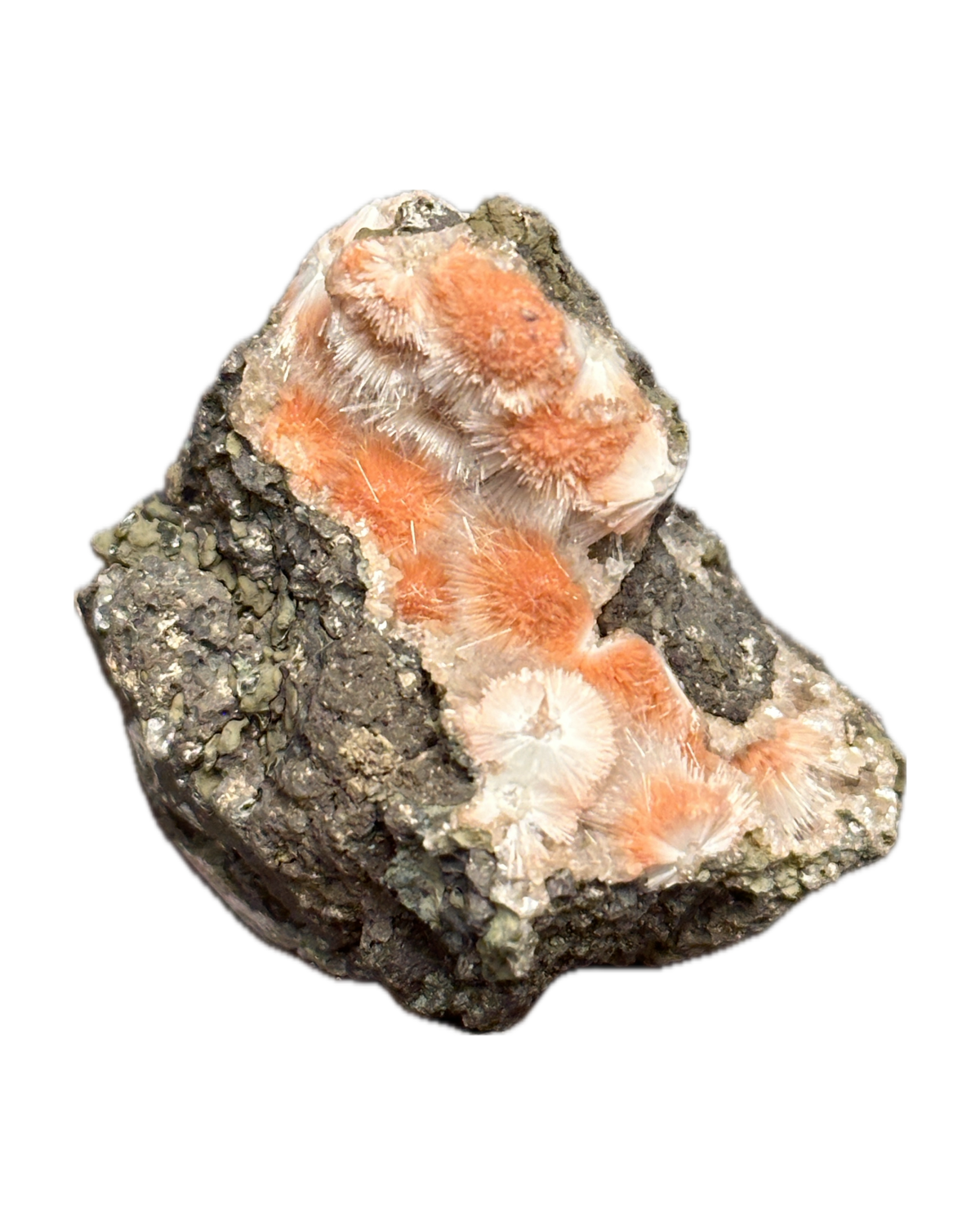
Thomsonita is a mineral with formula (Na,Ca)₂Al₅Si₅O₂₀·6H₂O, in the Silicatos (Tectosilicatos) group. This specimen comes from Deshgoan, Madhya Pradesh, Madhya Pradesh, India.
Description
Orange radial thomsonite acicular crystals with white mesolite on dark grey volcanic matrix.
About Thomsonita
A rare zeolite, a member of the tectosilicate group, typical of cavities in Indian basalts. The association is characteristic of the region. It grows on the Decan Trap's vugs.
About the locality
The Deccan basalts allow for the formation of various zeolites, such as mesolite, stilbite, and many others that grow freely within their cavities. The history of this gigantic igneous province is fascinating. It once covered an area as extensive as the Iberian Peninsula and France combined, although today the size of the traps is roughly that of Spain itself. The eruption coincided with the dinosaur-killing meteorite 66 million years ago. Within that colossal magmatic flow, hundreds of billions of gas bubbles were trapped, creating the cavities where these wonders subsequently grew.
Technical data
- Catalogue No.
- 0062
- Composition
- (Na,Ca)₂Al₅Si₅O₂₀·6H₂O
- Name
- Thomsonita
- Group
- Silicatos (Tectosilicatos)
- Category
- Cavella
- Matrix
- Basalto
- Associations
- mesolita
- Mine
- Deshgoan
- District / Municipality
- Madhya Pradesh
- Province
- Madhya Pradesh
- Country
- India
- Size (cm)
- 46 x 33 x 44
- Weight
- 56 g
- Etymology
- It is named in honour of the Scottish geologist Thomas Thomson (1773–1852), who identified the mineral in 1820.
- Quality
- Buena
- Value trend
- Estable
Related specimens
- Calcedonia Estalactítica — India
- Drusa (Geoda) —
- Escolecita — India
- Hackmanita — Afganistán
- Mordenita — India
- Cuarzo — España
- Cuarzo — España
- Analcima — España