Estibina
Estibina is a mineral with formula Sb₂S₃, in the Sulfuros group. This specimen comes from Mina Wuning, Qingjiang, Jiujiang, Jiangxi, China.
Description
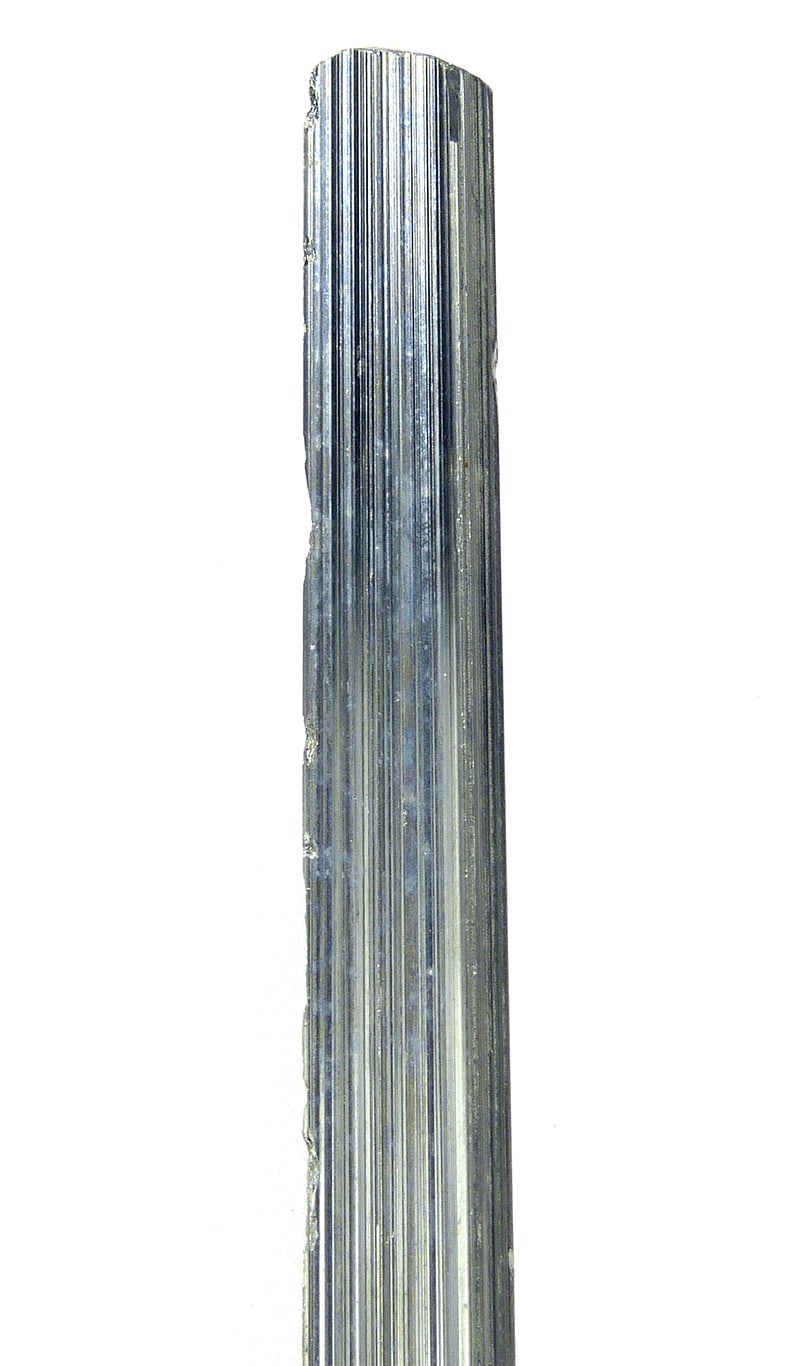
Large prismatic stibnite crystal, lustrous and solid, with well-defined longitudinal striations along its entire length. Shows high metallic lustre and linear symmetry, with a partial termination. Matrix-free specimen of pure, vertical geometry.
History of this specimen
This piece survived a fall in July 2025 caused by my using Blu Tack instead of silicone to secure it. Despite the impact, it lost only one acicular crystal and retains its sculptural structure intact.
About Estibina
Long before it was defined as Antimonite Sulfide Sb₂S₃, stibnite was ground in Egypt to make kohl, a medicinal eye protector found in tombs next to the raw mineral. Its linguistic journey evolved from the Greek platyophthalmos ("bright-eyed") to the Latin stibium, the word from which we inherit the chemical symbol Sb.
About the locality
Wuning Mine (Jiangxi) is noted for large prismatic stibnite with stable metallic lustre, considered among the best worldwide. Since 2022, the export of stibnite from China has been subject to increasingly strict controls, which has greatly reduced its availability.
Technical data
- Catalogue No.
- 0090
- Composition
- Sb₂S₃
- Name
- Estibina
- Group
- Sulfuros
- Category
- Estélites
- Mine
- Mina Wuning
- District / Municipality
- Qingjiang
- Province
- Jiujiang
- Region
- Jiangxi
- Country
- China
- Size (cm)
- 14.5 x 1.2 x 1
- Weight
- 45.2 g
- Etymology
- The name 'stibnite' spans more than two millennia. In Classical Greek it was stíbi or stimmi, and also platyophthalmos, 'bright-eyed', in allusion to its cosmetic use. The Romans adopted stibium, source of the chemical symbol Sb for antimony. Over time the mineral acquired other names—such as antimonite, with its apocryphal 'monk-killer' tale of well-meaning alchemists—and again stibine—that reflect the languages and periods that sought to name it.
- Quality
- Notable
- Value trend
- Estable
Related specimens
- Oropimente — China
- Piromorfita — China
- Esfalerita (Marmatita) — Rusia
- Estibina — Rumanía
- Estibina — Rumanía
- Estibina — Rumanía
- Realgar — Rumanía
- Pararealgar — Rumanía