Torbernita
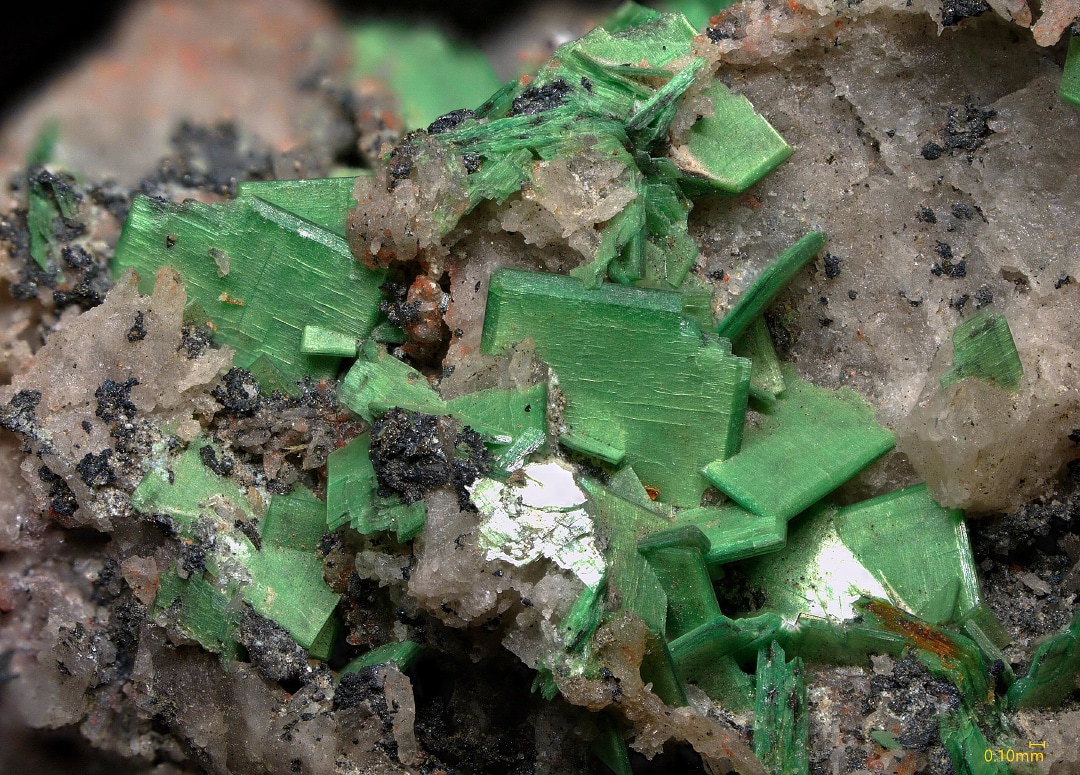
Torbernita is a mineral with formula Cu(UO₂)₂(PO₄)₂·8–12H₂O, in the Fosfatos group. This specimen comes from Svornost, Jáchymov, Karlovy Vary, Bohemia, República Checa.
Description
Very small specimen with small, well-formed tabular crystals of emerald-green torbernite. Emits 1.50 µSv/h.
History of this specimen
Small historical piece. It stands at the boundary between two eras: the enlightened 19th-century cabinet-collecting and the scientific discovery that transformed the understanding of matter and energy. It is accompanied by the original handwritten label and a period box. I date the handwritten label to between 1890 and 1915. The term "Uran(g)min" was common in 19th-century German mineralogical usage. Urangmin = Uranig-Mineral / Uran-Gesteinsmineral → abbreviated. That inserted 'g' places the label in 1890–1910, as it is a transitional Germanism that later disappeared. Until 1918, Bohemia belonged to the Austro-Hungarian Empire and the official name of the district was Joachimsthal. After the First World War and the creation of Czechoslovakia, the German names were replaced by their Czech forms (Jáchymov). The script on the label—a cursive with very upright letters and fine strokes—is not Sütterlin (1911–1941), but an earlier form, Kurrentschrift, used in the 19th century. The period supports, yellowish paper with a fibrous texture, also match Central European cabinets prior to 1920, before the generalised use of whiter papers and printed or typewritten labels. And in those years in particular, the Curies were isolating polonium and radium from pitchblende from this same region, Joachimsthal, the principal European centre of uraninite extraction in the Austro-Hungarian Empire.
About Torbernita
Torbernite is a hydrated copper-uranium phosphate, one of the most characteristic secondary uranium minerals. It forms by alteration of uraninite in oxidising environments.
About the locality
The Jáchymov district (pronounced "yajimof"; formerly Joachimsthal) is a major historic locality. Jáchymov’s history runs in successive phases: first silver; then cobalt and nickel salts for colouring ceramics and glass; and later the so-called uranium salts, used mainly in Bohemian glass. Later, the district’s pitchblende reached the Curies, linking the place with the discovery of radioactivity in 1896 and, shortly after, of polonium and radium in 1898. To grasp how scarce and valuable the latter element was, one detail suffices: in Jáchymov they keep a commemorative plaque marking the moment when, after nearly 30 years of mining, they managed to gather 100 grams. That gives a measure of its rarity, because mining works in tonnes, not grams. Later, the locality entered fully into the 20th-century nuclear race and, when it seemed impossible to add another layer, the communist coup of 1948 turned the same mining district into a forced-labour enclave for the Soviet programme. Until de-Stalinisation began in 1953, the regime sent thousands of intellectuals, political prisoners and dissidents there to extract uranium by hand to feed its nuclear programme. The Svornost Mine is the oldest uranium mine in the world and the oldest mine still in use in Europe.
Technical data
- Catalogue No.
- 0217
- Composition
- Cu(UO₂)₂(PO₄)₂·8–12H₂O
- Name
- Torbernita
- Group
- Fosfatos
- Category
- Núcleus Ardens
- Matrix
- Granítica
- Mine
- Svornost
- District / Municipality
- Jáchymov
- Province
- Karlovy Vary
- Region
- Bohemia
- Country
- República Checa
- Size (cm)
- 2 x 2 x 0.8
- Weight
- 1.8 g
- Ex-collection
- Gabinete mineralógico centroeuropeo
- Etymology
- Named for the Swedish chemist Torbern Olof Bergman (1735–1784), a pioneer in the study of uranium compounds.
- Quality
- Top
- Value trend
- Al alza
Related specimens
- Ópalo (Hialita) — República Checa
- Piromorfita — China
- Uranofana — España
- Torbernita — España
- Anapaita — España
- Tectita (Moldavita) — República Checa
- Ludlamita — Brasil
- Vivianita — Brasil