Metatorbernita
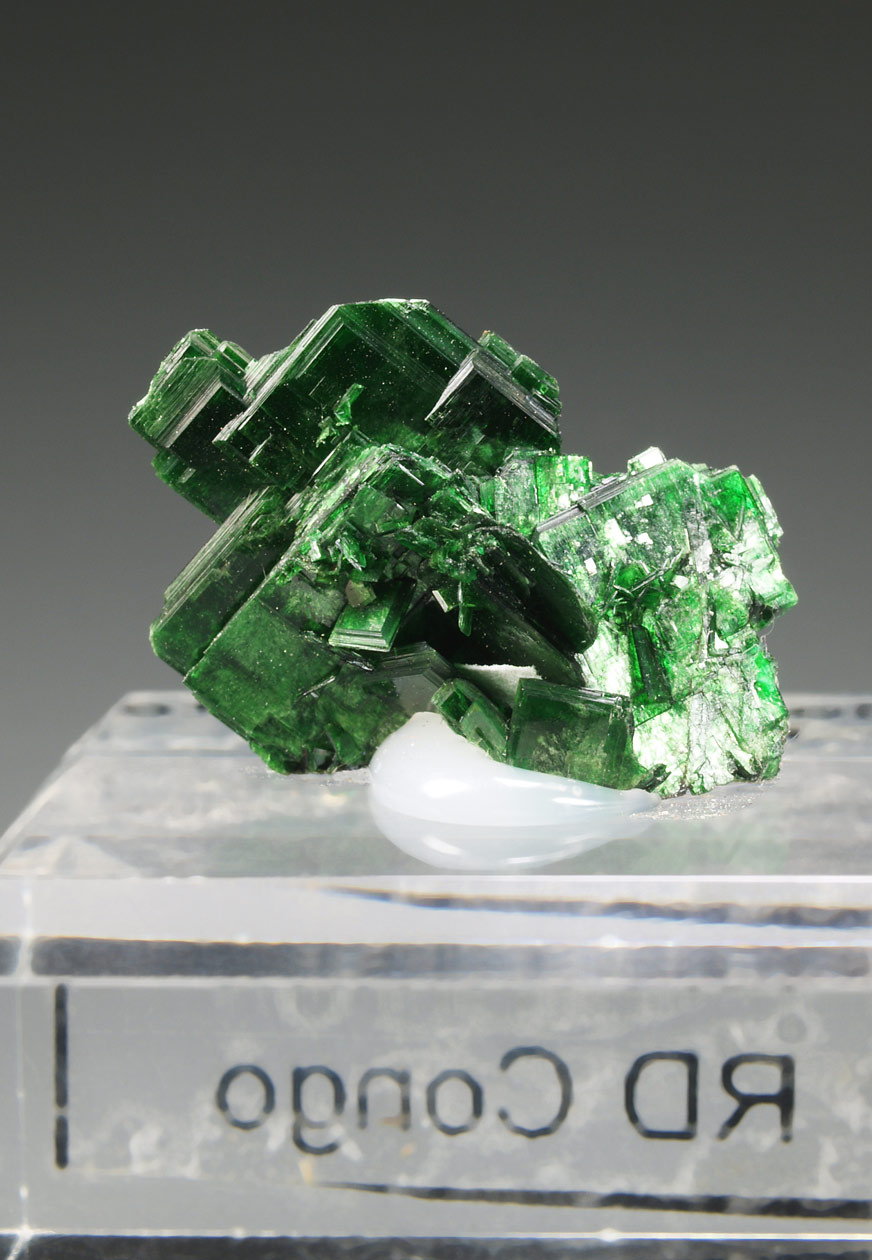
Metatorbernita is a mineral with formula Cu(UO₂)₂(PO₄)₂·8H₂O, in the Fosfatos group. This specimen comes from Shinkolobwe Mine, Shinkolobwe, Katanga Copper Crescent, Alto Katanga, República Democrática del Congo (ex-Zaire).
Description
Exceptional small miniature, 360° display, deep homogeneous green, with large, thick tabular crystals, well stacked, and pronounced three-dimensional volume.
History of this specimen
Bought it in 1975 for $100; it belonged to David P. Wilber, one of the most influential collectors of the 20th century. His personal collection rarely exceeded thirty-five to fifty pieces, methodically selected. Such was his influence that his surname gave rise to the term "wilber", used to describe a minimal micro-damage that, even in exceptional specimens, affects its valuation. Before acquiring a specimen, Wilber cross-checked its quality by always asking the same questions: "How would you rate this specimen on a scale of 1 to 10? Have you seen better ones? If so, how many? How rare is this mineral? Is the locality still producing?" That this Shinkolobwe metatorbernite passed through his collection indicates that it met an extremely demanding criterion, focused on overall quality rather than absolute perfection. I am proud to have it in my collection.
About Metatorbernita
Metatorbernite is a hydrated copper-uranyl phosphate, formed as a secondary mineral in the oxidised zones of uranium deposits. It commonly derives from the dehydration of torbernite and retains its characteristic green laminae, hence historical names such as "Uranglimmer", literally "uranium mica". It shared that designation with its calcium cousin, autunite: both show a micaceous platy habit, one green and the other yellow.
About the locality
Before the Second World War, the Belgian Union Minière du Haut-Katanga mined the deposit and stockpiled the material without a clearly defined use. In 1940, fearing a Nazi invasion, the company director, Edgar Sengier, shipped almost all the Shinkolobwe stock to New York, which both provided feed for the Manhattan Project and kept that high-grade uranium out of German reach. Thus, although the Third Reich, with scientists such as Werner Heisenberg, attempted to develop its own nuclear programme, the lack of access to that material decisively limited its prospects. After the war, the area was militarised and the mine left the civil circuit. Although the mine officially closed in 2004 and precarious artisanal mining exists today, for high-level collecting the story had ended much earlier. Hence old labels are not a romantic detail but their certificate. A metatorbernite from this provenance and bearing Wilber’s stamp is not interchangeable with another, however similar it may look.
Technical data
- Catalogue No.
- 0304
- Composition
- Cu(UO₂)₂(PO₄)₂·8H₂O
- Name
- Metatorbernita
- Group
- Fosfatos
- Category
- Núcleus Ardens
- Mine
- Shinkolobwe Mine
- District / Municipality
- Shinkolobwe
- Province
- Katanga Copper Crescent
- Region
- Alto Katanga
- Country
- República Democrática del Congo (ex-Zaire)
- Size (cm)
- 2.7 x 2 x 1
- Weight
- 8 g
- Ex-collection
- David P Wilber
- Etymology
- Torbern Olof Bergman's eponimfor his contributions to analytical chemistry.
- Quality
- Top
- Value trend
- Al alza
Related specimens
- Piromorfita — China
- Uranofana — España
- Torbernita — España
- Anapaita — España
- Ludlamita — Brasil
- Vivianita — Brasil
- Vivianita — Brasil
- Torbernita — España