Vivianita
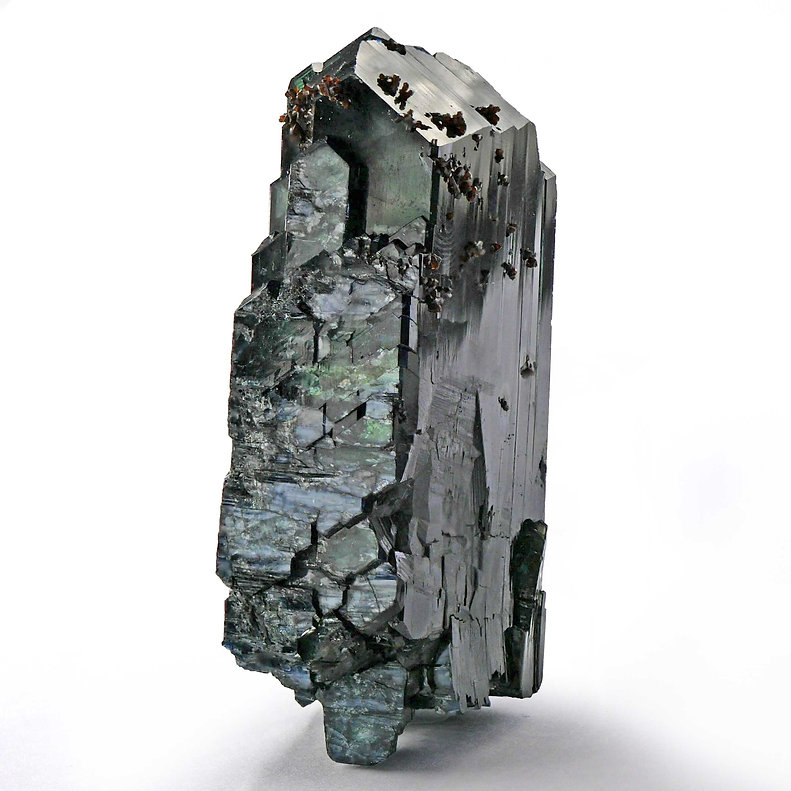
Vivianita is a mineral with formula Fe²⁺₃(PO₄)₂·8H₂O, in the Fosfatos group. This specimen comes from Mina Siglo Veinte, Llallagua, Rafael Bustillo, Potosí, Bolivia.
Description
La San Juan, 1967. Large floater vivianite crystal, thick and robust, very dark blue-green. A discontinuous honey-coloured childrenite seam runs across three faces. A sharp linear groove marks the crystal.
History of this specimen
It is the piece I gave myself for my 48th birthday. Labelled "Catavi Mine", but in reality virtually all specimens come from the Siglo Veinte Mine, as Catavi has yielded scarcely any—or none have been obtained. The number recalls the year of the massacre.
About Vivianita
Necromineral linked to processes of organic decomposition in iron-rich environments. It forms when phosphate from decomposing human or animal bodies comes into contact with water and iron. There are cases where vivianite has been found in mammoth tusks and in corpses buried for several centuries. It is photosensitive and degrades, oxidising, shifting from blue to green.
About the locality
Historic tin district marked by violence against the labour movement and its forced dismantling. In 1942, the Catavi mine suffered an initial massacre when the army repressed the miners under the pretext of guaranteeing ore exports to the United States during the Second World War. In 1967, during the Barrientos dictatorship, the army attacked the Siglo Veinte camp at dawn while families celebrated San Juan: a punitive operation with gunfire against women, children and workers to crush the miners' unionism and its affinity with Che. Decades later, after the tin price collapse, the IMF and the World Bank imposed the closure of state mining and the dismissal of tens of thousands of miners. Many moved to the Chapare, where they rebuilt union structures that would give rise to the coca-growers' movements and, in time, to the leadership of Evo Morales. Today extraction persists in fragmented, self-managed cooperatives, but the classic vivianites of this district are increasingly difficult to find.
Technical data
- Catalogue No.
- 1967
- Composition
- Fe²⁺₃(PO₄)₂·8H₂O
- Name
- Vivianita
- Group
- Fosfatos
- Category
- Estélites
- Associations
- childrenita
- Mine
- Mina Siglo Veinte
- District / Municipality
- Llallagua
- Province
- Rafael Bustillo
- Region
- Potosí
- Country
- Bolivia
- Size (cm)
- 7.5 x 3 x 2.5
- Weight
- 104.2 g
- Ex-collection
- Christian Weise
- Etymology
- In honour of John Henry Vivian (1785–1855), British mineralogist and politician who discovered it in 1817.
- Quality
- Top
- Value trend
- Al alza