Fluorapatito
Fluorapatito is a mineral with formula Ca₅(PO₄)₃(F,Cl,OH), in the Fosfatos group. This specimen comes from Mina La Celia, Jumilla, Murcia, Región de Murcia, España.
Description
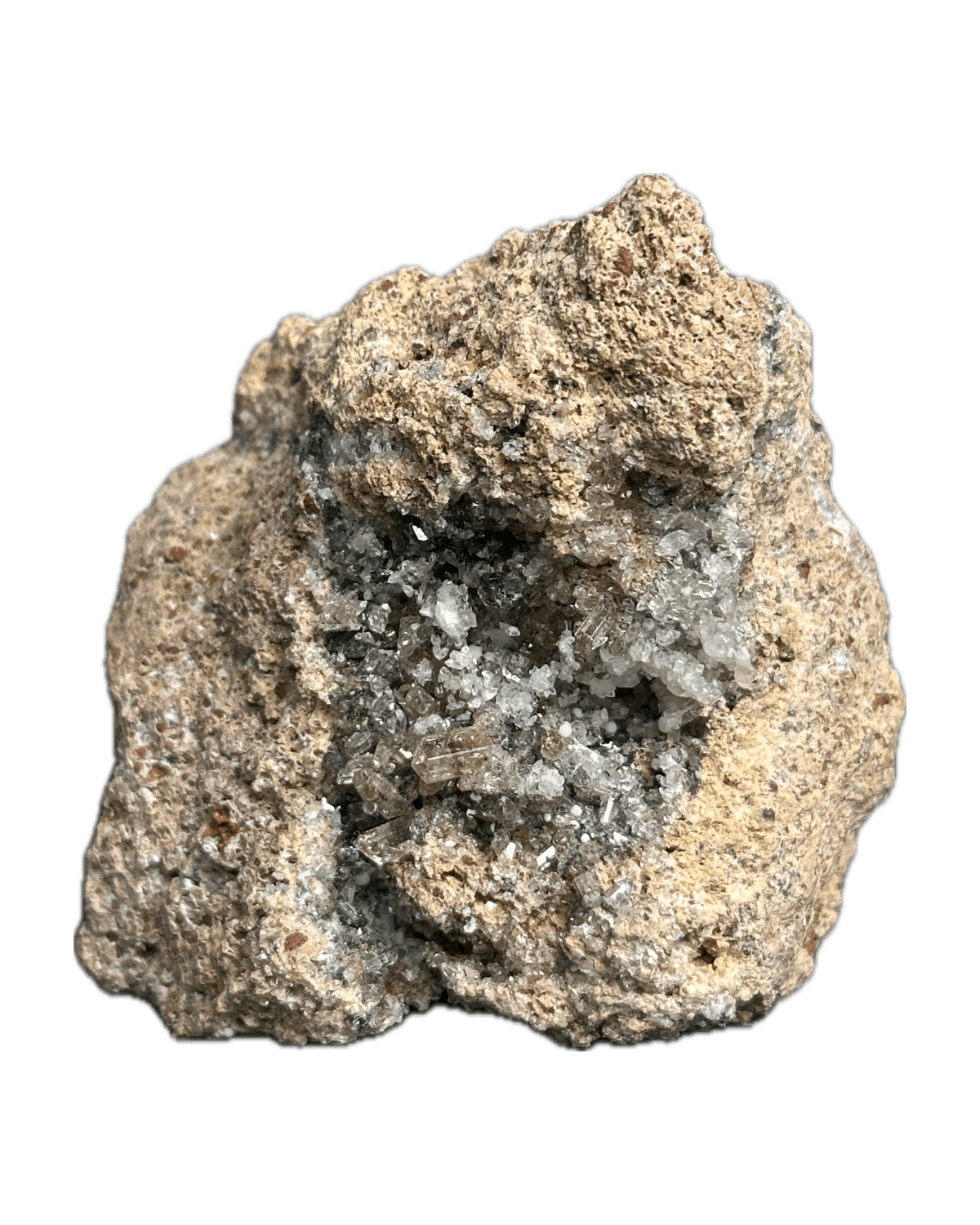
Apatite crystals on matrix, in a partially open cavity. Pale yellow-green colour, good vitreous lustre, short prismatic habit.
About Fluorapatito
Traditionally known as the Jumilla apatites. Apatite is a calcium phosphate that belongs to a group of minerals with different anions (fluoride, chloride or hydroxyl). It is typically found in igneous or metamorphic settings, though it also occurs in hydrothermal veins. The name covers several species, all sharing a hexagonal crystal structure and vitreous lustre. At La Celia it occurs as well-defined crystals, yellowish to greenish in colour.
About the locality
La Celia is closed, protected and fenced, with access prohibited and penalties for extracting material. The closure primarily reflects its status as a protected area due to bat colonies. For years it was a classic pilgrimage site for collectors—especially the initiated—and, although there was talk of mineralogical plundering, that argument rather reinforced the decision to close it. It has been one of the best-known Spanish deposits of this ultrapotassic environment, noted for its apatites and for rare parageneses in small cavities in the rock. Although it never had large-scale production, it yielded well-formed specimens much prized by collectors.
Technical data
- Catalogue No.
- 0029
- Composition
- Ca₅(PO₄)₃(F,Cl,OH)
- Name
- Fluorapatito
- Group
- Fosfatos
- Category
- Cavella
- Mine
- Mina La Celia
- District / Municipality
- Jumilla
- Province
- Murcia
- Region
- Región de Murcia
- Country
- España
- Size (cm)
- 7 x 6 x 6
- Weight
- 145 g
- Etymology
- The term "apatite" derives from the Greek "apatein", meaning "to deceive", because of its resemblance to other minerals. It was so named in 1786 by Abraham Gottlob Werner.
- Quality
- Buena
- Value trend
- Estable
Related specimens
- Aragonito (Blanco (Bulboso)) — España
- Barita — España
- Calcita (Dorada) — España
- Jacinto de Compostela — España
- Magnetita — España
- Magnetita — España
- Malaquita (Microbotrioidal) — España
- Piromorfita — China