Vesuvianita
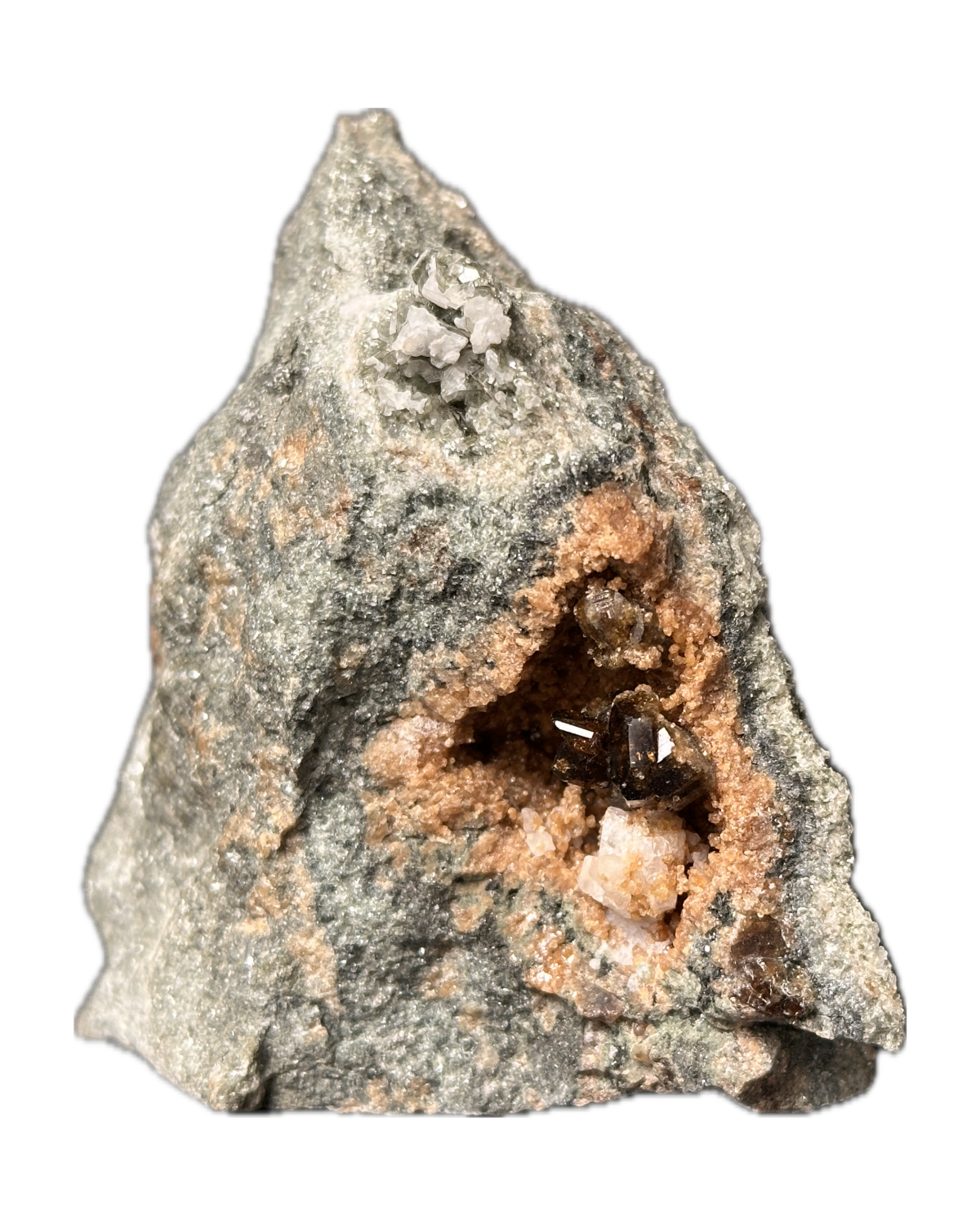
Vesuvianita is a mineral with formula Ca₁₉(Al,Mg,Fe)₁₃(SiO₄)₁₀(Si₂O₇)₄(OH)₁₀, in the Nesosilicatos group. This specimen comes from San Vito, Vesubio, Ercolano, Metropolitan City of Naples, Campania, Italia.
Description
Well-formed, lustrous amber-brown vesuvianite crystals in a cavity lined with hundreds of thousands of minute grossular garnets. Dark green matrix. Calcite fluoresces orange under UV.
About Vesuvianita
Vesuvianite is a calcium–aluminium silicate with a complex structure. Its crystal lattice contains several sites that can accommodate cations of similar size and charge. An emblematic species of Vesuvius, where it was first discovered and described. Known for its tetragonal prisms and green or brown colours. The specimen comes from one of the most classic areas.
About the locality
TYPE LOCALITY. Vesuvius is the volcano that in AD 79 destroyed Pompeii and Herculaneum. Mount Somma constitutes the remnant of the ancient volcanic edifice. Today it forms part of a national park and collecting is not permitted.
Technical data
- Catalogue No.
- 0035
- Composition
- Ca₁₉(Al,Mg,Fe)₁₃(SiO₄)₁₀(Si₂O₇)₄(OH)₁₀
- Name
- Vesuvianita
- Group
- Nesosilicatos
- Category
- Cavella
- Matrix
- Matriz metamórfica
- Associations
- Calcita Cuarzo Mica
- Mine
- San Vito
- District / Municipality
- Vesubio, Ercolano
- Province
- Metropolitan City of Naples
- Region
- Campania
- Country
- Italia
- Size (cm)
- 10 x 7.5 x 4
- Weight
- 315.8 g
- Etymology
- Also called "idocrase", it was first known as "dodecahedral hyacinth" and later as "Vesuvius hyacinth". In 1795 Abraham Gottlob Werner formally described it and named it "Vesuvian" (vesuvianite) in reference to its type locality.
- Quality
- Muy buena
- Value trend
- Al alza
Related specimens
- Barita — Italia
- Barita (Amarilla) — Italia
- Calcita (Botrioidal Amarilla) — Italia
- Malaquita — Italia
- Bomba volcánica — Italia
- Heulandita-Ca (Roja) — Italia
- Andradita (Melanita) — Marruecos
- Titanita — Marruecos