Celestina
Celestina is a mineral with formula SrSO₄, in the Sulfatos group. This specimen comes from La Segarra, Torà, Lleida, Catalunya, España.
Description
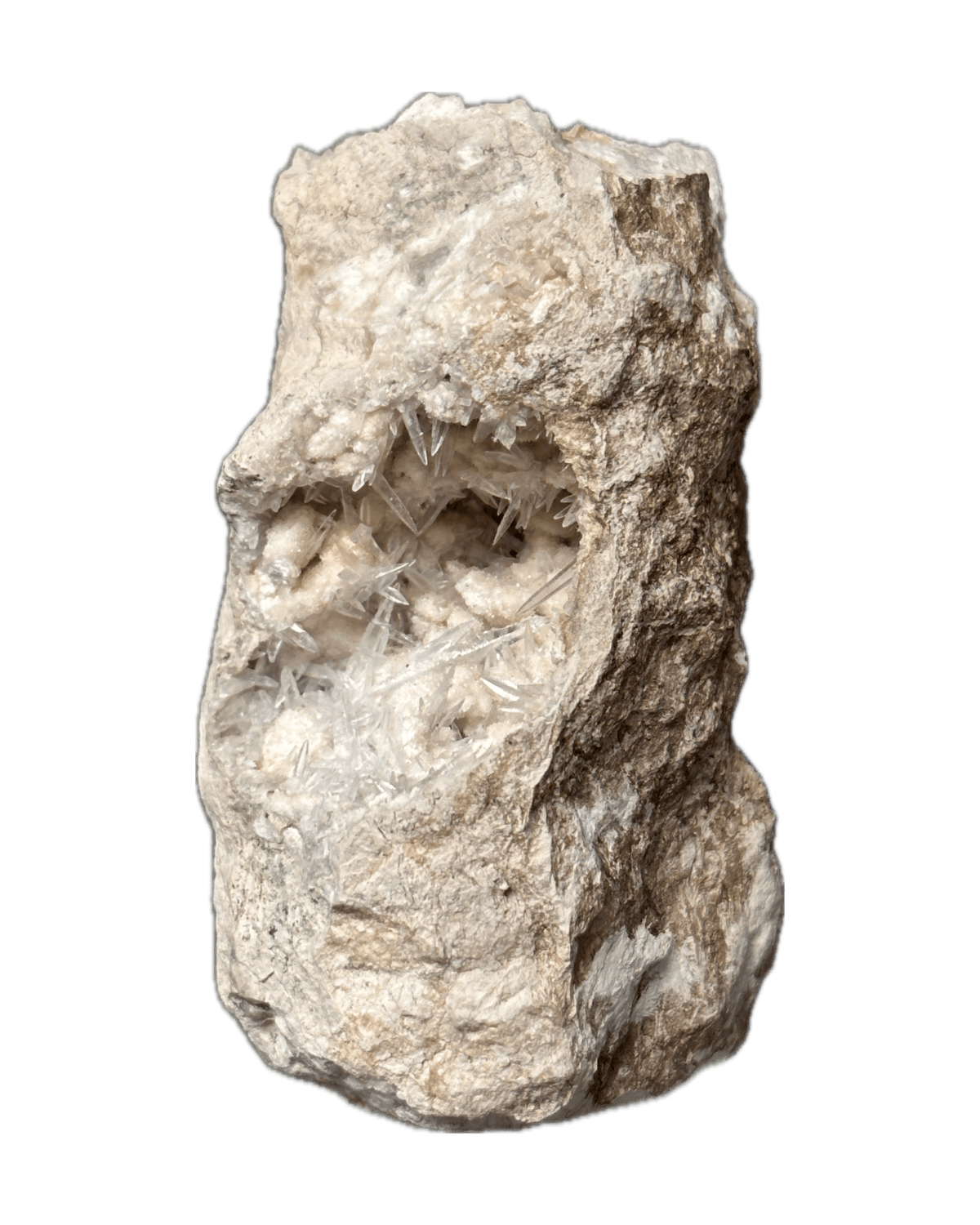
Elongate specimen: a geode of white celestine with well-defined acicular crystals arranged like 'teeth' on a druse of white calcite. The crystals are long, slender, transparent and very aesthetic, with aggressive growth into the cavity.
History of this specimen
This was collected it before the ban on access and extraction in the Torà area.
About Celestina
Strontium sulphate that commonly forms prismatic or acicular crystals, transparent to translucent, with vitreous lustre. It may occur in white, grey or bluish tones, depending on impurities. Celestine is the strontium analogue of barite with barium and anglesite in this case with lead. It is also the main source of strontium.
About the locality
About 40 million years ago, a shallow sea covered the area and, on evaporation, left deposits of salts, gypsum and sulphates. The accumulation of these layers, together with organic matter trapped in the marls, such as algae, led to the formation of celestine. The first significant deposit was discovered in the 1990s, with small bluish crystals. Later, colourless specimens appeared associated with gypsum, anhydrite and, occasionally, strontianite. In recent years, cavities have been found in indurated yellow marls, with larger bluish crystals hosted in nodules. The local authorities have expressed their displeasure at the large numbers of collectors. Extraction and collection of specimens are currently prohibited. Torà ceased to belong to La Segarra and is now part of Solsonès.
Technical data
- Catalogue No.
- 0142
- Composition
- SrSO₄
- Name
- Celestina
- Group
- Sulfatos
- Category
- Cavella
- Matrix
- Marga miocena
- Associations
- Calcita
- Mine
- La Segarra
- District / Municipality
- Torà
- Province
- Lleida
- Region
- Catalunya
- Country
- España
- Size (cm)
- 8 x 7.5 x 5
- Weight
- 135 g
- Etymology
- Celestine received several names between 1791 and 1800, before its current name was established, derived from the Greek "coelestis" ('celestial') for its blue colour. Although good crystals were already known from Sicily, they were not correctly identified until the discovery of strontium at the end of the 18th century.
- Quality
- Muy buena
- Value trend
- Estable
Related specimens
- Aragonito (Blanco (Bulboso)) — España
- Barita — España
- Barita — Italia
- Barita (Amarilla) — Italia
- Calcita (Dorada) — España
- Celestina — Madagascar
- Jacinto de Compostela — España
- Magnetita — España