Torbernita
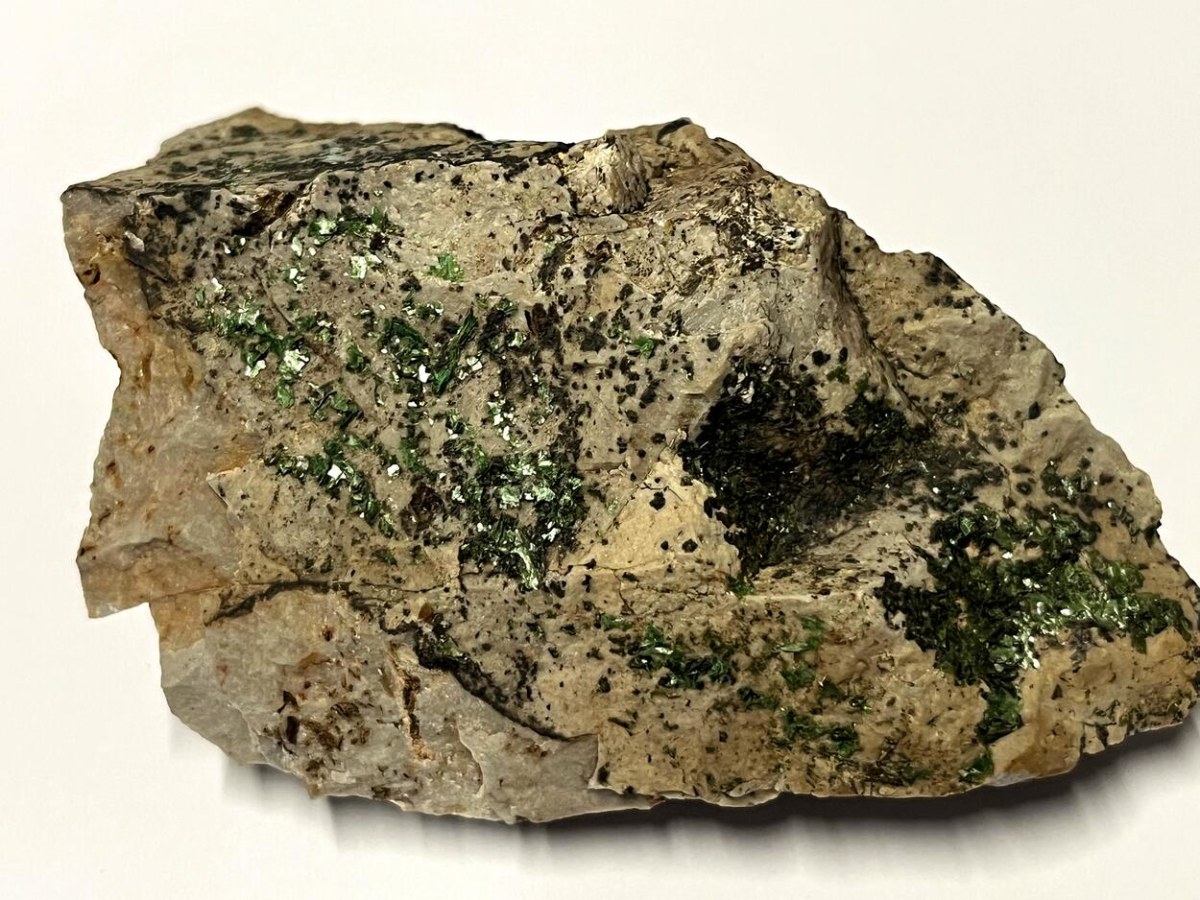
Torbernita is a mineral with formula Cu(UO₂)₂(PO₄)₂·12H₂O, in the Fosfatos group. This specimen comes from Batolito de Los Pedroches, Cardeña, Córdoba, Andalucía, España.
Description
Small laminar crystals of grass-green torbernite dispersed like glitter on a large siliceous matrix.
History of this specimen
Acquired in 2025 at an exceptional price, this rare and highly sought-after Spanish torbernite comes from a mine that is now closed and restored, and it emits a radioactivity of 11 µSv/h. Beyond its mineralogical value, the piece has a unique history dating back to the autumn of 2005. At that time, thanks to Inmaculada Ramos's research in historical archives, Antonio Carmona, the late Juan Miguel Jiménez, and the original owner located an old mineralization in Cardeña; after clearing dirt and moss from a seemingly barren metamorphic rock face, these specimens came to light. Each of them collected a box and never returned to the site. Years later, José Ignacio lost his specimens during a move, until in 2025 he managed to recover this very piece at the Adra micromineral fair through a trade with Antonio Carmona, giving him rare selenium and tellurium minerals from Rodalquilar in exchange.
About Torbernita
Torbernite is a uranium-copper phosphate that forms in the oxidised zones of uraniferous veins. Its tabular plates develop by precipitation from hydrothermal solutions in granite fractures.
About the locality
Trapero mine is part of a group of uraniferous deposits worked in the second half of the 20th century. The first signs of radioactivity were detected in 1953 by the Junta de Energía Nuclear and, shortly afterwards, ore extraction began; the material was sent to the uranium plant at Andújar to produce the so-called "yellowcake". In the early years, the material was transported in lorries and open wagons without radiological protection measures, and the miners’ clothes were washed at home with the rest of the family’s laundry. Mining ended in 1970. Between 1997 and 2000, ENRESA carried out environmental restoration at nineteen former uranium mines in Andalusia and Extremadura. Shafts and raises were backfilled with waste-rock material and sealed with concrete slabs; open pits were filled, installations were demolished, and the surroundings were replanted with native species. Today the mine lies within a Natural Park, covered by metres of soil and vegetation.
Technical data
- Catalogue No.
- 0218
- Composition
- Cu(UO₂)₂(PO₄)₂·12H₂O
- Name
- Torbernita
- Group
- Fosfatos
- Category
- Núcleus Ardens
- Matrix
- Matriz silícea
- Mine
- Batolito de Los Pedroches
- District / Municipality
- Cardeña
- Province
- Córdoba
- Region
- Andalucía
- Country
- España
- Size (cm)
- 10.5 x 7 x 5
- Weight
- 295 g
- Ex-collection
- José Ignacio Ramos
- Etymology
- Named after the Swedish chemist Torbern Olof Bergman, who studied its properties in the 18th century.
- Quality
- Muy buena
- Value trend
- Estable
Related specimens
- Aragonito (Blanco (Bulboso)) — España
- Barita — España
- Calcita (Dorada) — España
- Jacinto de Compostela — España
- Magnetita — España
- Magnetita — España
- Malaquita (Microbotrioidal) — España
- Piromorfita — China